


A Complete Guide to Telescopic Boom Cranes: Uses, Telescopic Crane Mechanism, and Choosing the Right Model
A telescopic boom crane is chosen when a lift requires variable reach without the transport and assembly burden of a lattice boom. Its value is not simply that the boom extends: it is that the operator can match radius, hook height, and access constraints to a changing work area. That makes telescopic cranes useful on construction sites, in industrial maintenance, at logistics yards, and in confined facilities where the lifting point is not fixed.
The central selection issue is often misunderstood. Maximum lifting capacity alone does not define whether a crane can perform a lift. Capacity falls as working radius increases, ground conditions affect stability, and the boom configuration determines whether the hook can reach the required point without creating an unsafe operating condition. A suitable crane is therefore one whose load chart, dimensions, travel arrangement, and safety systems fit the actual lift plan rather than the nominal weight of the load.
Where telescopic boom cranes add practical value
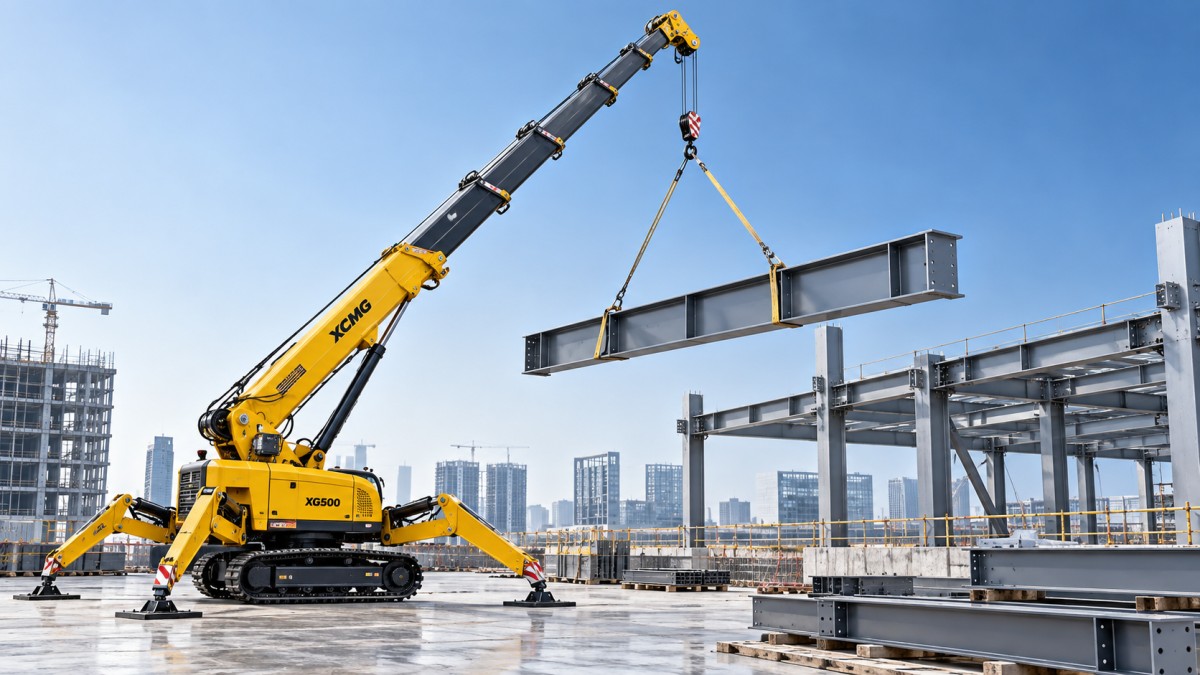
Telescopic booms are common on truck cranes, rough-terrain cranes, all-terrain cranes, crawler-mounted compact cranes, and spider cranes. Their applications differ, but the operating logic is similar: the boom can be shortened for travel or close-in work, then extended to gain height or horizontal reach.
On building projects, telescopic cranes lift structural members, precast elements, HVAC units, formwork, and site materials. Their advantage is rapid repositioning as the workfront moves. In infrastructure work, they may handle bridge components, utility sections, lighting poles, or equipment installed from a roadside position where the crane must work over barriers or excavations.
Industrial lifting presents a different set of constraints. Equipment replacement inside a plant may be limited by door widths, low headroom, floor loading, operating machinery, and restricted outrigger positions. A compact telescopic crane can be more useful than a larger mobile crane if it can enter the building, stabilize correctly, and provide the required hook height at the actual radius. In ports and logistics yards, telescopic cranes are also used for machinery handling and irregular loads where fast setup and flexible reach matter more than repetitive high-cycle lifting.
Not every lifting task favors a telescopic boom. A tower crane can be more economical for sustained vertical distribution on a long-duration high-rise project. A lattice-boom crawler crane may be preferable for exceptionally heavy lifts, long radii, or applications requiring stable capacity over a broad working envelope. Telescopic equipment is strongest where mobility, setup speed, changing radius, and constrained access carry more weight.
How the telescopic crane mechanism works
A telescopic boom consists of nested steel sections. The base section is attached to the crane’s superstructure, while inner sections slide outward in sequence or through a synchronized arrangement. Extension is normally powered by hydraulic cylinders, ropes, chains, or internal telescoping systems designed by the crane manufacturer. Retraction brings the sections back into the base boom for transport, storage, or close-range lifting.
The mechanism does more than increase hook height. Extending the boom changes the geometry of the lift. As the load moves farther from the crane’s tipping axis, the overturning moment rises. For this reason, the permissible load at a long radius can be far lower than the crane’s headline rated capacity. The load chart accounts for boom length, boom angle, working radius, outrigger configuration, counterweight where applicable, and sometimes jib or fly-jib use.
Boom extension must be coordinated with hoist operation. If the boom is extended while a load is suspended, the load radius may increase, potentially reducing the available capacity. The load may also swing if movement is abrupt. Controlled hydraulic motion, correct reeving, functional limit devices, and trained operation are essential because the risk comes from the combined effect of boom angle, radius, load weight, and ground support—not from any one factor in isolation.
Modern telescopic cranes commonly use sensors and rated capacity limiters to monitor boom length, angle, pressure, and configuration. These systems are important safeguards, but they do not replace lift planning. Incorrect configuration input, an unaccounted rigging weight, poor ground bearing capacity, or an obstacle that forces the operator to work at a larger radius can still invalidate an otherwise acceptable calculation.
The load chart is the real starting point
Selection should begin with the heaviest realistic lifted load, including slings, shackles, lifting beams, hooks, and any below-the-hook attachment. That total must then be checked at the farthest required radius and required hook height. A crane that can lift the object at a short radius may not be able to place it at the installation point.
Hook height deserves separate attention. The required elevation is not merely the top of the item being installed. It includes clearance for the rigging, hook block, boom-head geometry, and a safe path over obstacles. In indoor work, the available headroom may limit boom angle before rated capacity becomes the constraint. Conversely, outdoor work may be radius-limited because the crane must remain outside an excavation, behind a perimeter fence, or clear of buried services.
Load charts also assume specified setup conditions. Outriggers may need to be fully extended, partially extended, or omitted depending on the model and mode. Capacities can differ substantially between these configurations. A lift should never be assessed using a favorable chart entry that cannot be achieved at the site.
Ground, access, and setup can decide the model
Crane stability begins below the machine. Outrigger pads spread load but do not create bearing capacity; the supporting soil, slab, deck, or temporary works must be capable of carrying the imposed reactions. Soft ground, unprotected trenches, backfilled areas, suspended floors, and underground voids require particular engineering attention. Leveling is equally important because rated charts are generally based on a level machine. Even a small slope can alter load distribution and reduce stability margin.
Access limitations often explain why a compact crawler or spider crane is selected over a conventional road-mobile machine. Gate width, corridor turns, floor loading, internal ramps, and travel route gradients should be checked before delivery. The crane’s transport dimensions are only part of the question: the machine may need room to turn, deploy outriggers, rotate the superstructure, and maintain exclusion zones during the lift.
For rough or unfinished ground, tracked undercarriages can provide lower ground pressure and more controlled travel than wheeled units, although they do not eliminate the need for site preparation. Wider track geometry and a robust outrigger footprint can improve stability, but neither feature permits operation beyond the published load chart or on ground that has not been verified.
Choosing boom length without over-specifying the crane
Longer boom is not automatically better. A longer boom can reach over structures and reduce the need to relocate the crane, but it may add machine weight, transport complexity, and cost. It can also create a lower capacity at the target radius than a shorter, heavier-duty configuration. The right approach is to map the lifting envelope: pick positions available to the crane, measure radius to the load center, identify obstructions, and calculate the hook height needed at each position.
For repetitive work, consider the range of routine lifts rather than the single largest lift. A crane selected solely for one extreme task may be inefficient for daily handling. On the other hand, selecting too close to the calculated limit leaves little allowance for changed rigging, minor placement adjustments, or unexpected access restrictions. The selection margin should reflect the criticality and variability of the work, while remaining within the manufacturer’s published operating limits.
When a tracked spider crane is a better fit
Compact high-capacity spider cranes occupy a specific niche between small indoor lifting equipment and larger mobile cranes. They can be relevant where substantial loads must be handled through narrow access routes or from a stabilized position on difficult construction ground. The combination of a telescopic boom, crawler travel, and outriggers is particularly useful when access and setup space are more restrictive than the lifted weight alone.
For example, the 12Ton Large-size Steel Track Spider Crane uses a five-section, 5 m manganese-steel boom, with a stated maximum lifting height of 21 m and maximum working radius of 19 m. These figures describe an operating envelope, not a 12-ton capacity at every point within it. Its suitability must still be confirmed against the applicable load chart, outrigger arrangement, site bearing conditions, and the full lifted load. Features such as a reinforced crawler chassis, hydraulic outriggers, dual-speed hoist, and optional overload monitoring are relevant only when they support the specific lift plan and site constraints.
Safety checks that should precede every commitment
A crane purchase or rental decision should not be finalized until the lift can be translated into a workable site method. Confirm the load’s verified weight and center of gravity; the rigging arrangement; required radius and hook height; crane configuration; ground-bearing assessment; weather limitations; access route; overhead and underground hazards; and communication arrangements. Power lines require defined clearance and control measures under applicable local rules, not an improvised decision at the jobsite.
It is also important to distinguish machine capability from project readiness. A telescopic crane may have adequate chart capacity, yet the lift may still be unsuitable because the ground cannot support outrigger loads, the travel route cannot carry the machine, or the load cannot be controlled during placement. The most reliable model choice is the one that fits the complete lifting system: crane, ground, rigging, load, access, and operating procedure.
Telescopic boom cranes are highly adaptable lifting tools, but their flexibility makes disciplined selection more important, not less. Match the crane to the real working radius, hook height, configuration, and site constraints. That approach avoids the two most expensive errors in crane planning: hiring a machine that cannot complete the lift, or paying for excess capacity that the project cannot use.
Send Us A Message
Get a Quote
Regardless of whether you require general advice or specific support, we are happy to help you.