


When narrow access makes a crawler spider crane the practical choice
When a lifting plan begins with a standard crane chart but ends at a doorway, a low-clearance passage, or a congested plant room, the decision changes quickly. The question is no longer simply, “What can lift the load?” It becomes, “What can reach the load safely, fit into the site, and leave the project team with a workable schedule?”
That is where a Crawler Spider Crane often becomes a practical option. Its value is not that it replaces every mobile crane or truck-mounted unit. Rather, it addresses a specific and costly gap: lifting work in places where conventional equipment has enough capacity on paper but cannot physically position itself for the job.
For business evaluators, narrow-access lifting equipment should be assessed as a project-system decision. Purchase or hire cost matters, but so do access preparation, transport movements, rigging time, floor loading, disruption to other trades, and the operational risk created by working around structural restrictions.
Access is the first filter—not lifting capacity
It is tempting to start equipment selection with the weight of the heaviest item. That is necessary, but it is rarely sufficient on constrained sites. A crane with excellent rated capacity may be unusable if it cannot pass through the entrance, turn into the work zone, or establish a stable working footprint once inside.
A compact crawler-based spider crane is particularly relevant when the route to the lift is as challenging as the lift itself. Typical decision triggers include:
- Doorways, corridors, or service routes that rule out larger carrier-based cranes.
- Restricted headroom in industrial buildings, basements, tunnels, and plant areas.
- Indoor work where diesel emissions, noise, or ventilation limits affect machine choice.
- Limited outdoor set-up space beside a building, especially where traffic lanes must remain open.
- Projects requiring work on finished surfaces or locations with carefully managed ground-bearing limits.
- Equipment replacement projects where existing machinery must be removed through the same restricted route.
The key distinction is that “narrow access” is not only about machine width. Evaluators should map the entire travel path: gate opening, slopes, thresholds, turning points, overhead obstructions, temporary ramps, and the final crane set-up zone. A machine that clears the entrance by a few centimetres may still be impractical if it cannot make the turn after entry or deploy stabilisers within the available envelope.
Why crawler mobility changes the site conversation
Traditional mobile cranes depend on suitable approach roads, a stable set-up area, and enough clearance to deploy outriggers. Their strengths are clear on open sites: rapid road travel, larger capacities, and strong reach profiles. Yet those advantages can become secondary when the work is behind a building, below grade, or inside an operating facility.
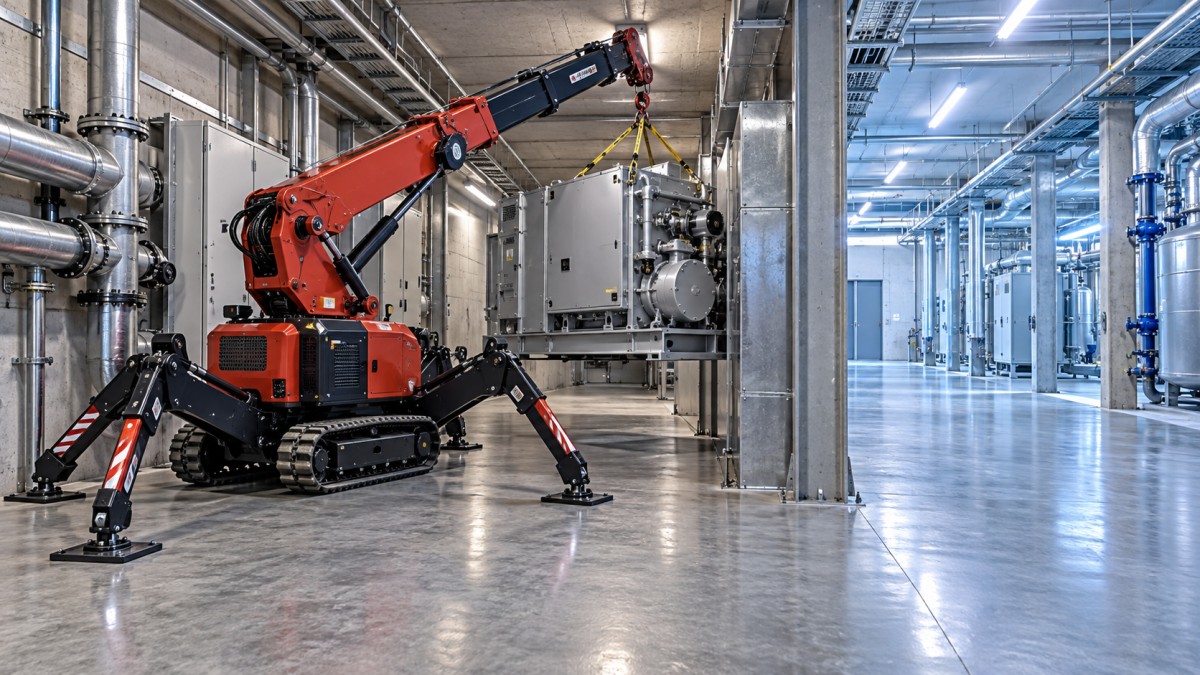
A Crawler Spider Crane brings controlled movement closer to the lifting location. Its tracked undercarriage helps it travel over uneven or prepared site surfaces, while the spider-style stabiliser arrangement can be positioned to suit confined set-up areas. This does not remove the need for ground assessment; it makes the assessment more specific. The team needs to understand each support point, available spreader-pad area, slab condition, and nearby underground services.
That flexibility can reduce secondary handling. Instead of using a large crane to land an item at the building edge and then relying on skates, forklifts, chain blocks, or manual repositioning, a compact crane may carry out more of the route under direct lifting control. Fewer transfers can mean fewer interface risks, particularly with high-value plant, glazed components, electrical assemblies, or awkward machinery.
Capacity charts still decide the answer
Compact access should never be mistaken for unlimited capability. A spider crane must be selected against the actual load at the actual radius, with the boom configuration, hook block, rigging, lifting beam, and attachments included. The headline weight of the item is only the start of the calculation.
Business evaluators should ask for a lift-specific chart review rather than accepting a maximum capacity figure. A machine may lift several tonnes close to its centreline but have substantially lower capacity at the radius required to clear a wall, reach through an opening, or place equipment beyond a barrier. Dynamic effects, wind exposure for external lifts, and the load’s centre of gravity also need attention.
It is useful to distinguish between a crane that can technically make a lift and one that can make it with sensible operational margin. A plan with little capacity reserve may require exceptionally precise positioning and tighter exclusion controls. That may be acceptable for a carefully engineered one-off lift, but it is a different commercial proposition from repeatable daily material handling.
Compare the alternatives by total work scope
The practical choice is often revealed by comparing the additional work each option creates. A truck crane may have a lower day rate, for example, but require road closure, removal of fencing, temporary ground improvement, longer pick radii, and a separate indoor handling solution. A spider crane may involve more detailed access planning but avoid several of those activities.
Likewise, a forklift can be the economical answer for regular palletised loads on level floors, but it is not a substitute for a crane when vertical placement, obstacle clearance, or suspended-load control is required. Chain hoists and gantry systems can work well for repetitive fixed-bay lifting, although they need suitable supporting structure and are less adaptable when the work area changes.
Articulating crane systems may also enter the shortlist for service trucks or compact loading tasks. For context, the HB100=6108 is a six-knuckle-boom crane designed to EN 12999 and DIN 15018, with a stated maximum rated capacity of 4,400 kg at 2.15 m and 435 kg at 13.75 m. Those figures illustrate a universal selection principle: lifting capacity is inseparable from radius. However, an articulating boom arrangement and a Crawler Spider Crane solve different access and mobility problems, so they should not be treated as interchangeable simply because their capacity ranges overlap.
Ground pressure and support reactions deserve early attention
Constrained sites often hide their greatest risk below the machine. Internal slabs may cover voids, service ducts, basements, or areas not intended for concentrated crane reactions. Outdoors, soft ground, recently backfilled trenches, drainage routes, and buried utilities can all influence the safe position of tracks and stabilisers.
Ask the equipment provider for machine weights, stabiliser reactions, outrigger geometry, and recommended pad arrangements for the intended configuration. Then compare those values with information from the site’s structural engineer or responsible facility manager. This is especially important when stabilisers must be unevenly positioned around obstacles; an apparently convenient set-up may change loading distribution significantly.
As a comparison point, compact crane products with stabilisers may publish maximum ground-pressure data. The HB100=6108, for example, lists maximum stabiliser ground pressure of 4.10 MPa. That does not establish suitability for another machine or site, but it reinforces why generic statements such as “the floor is concrete” are not an adequate engineering check.
Questions that expose a weak lifting proposal
Before approving a crawler spider crane arrangement, evaluators can use a short set of practical questions to test whether the proposal is mature:
- Has the supplier reviewed a measured access route rather than a verbal description?
- Does the lift plan show the machine position, stabiliser positions, radius, boom path, and load landing area?
- Are the load weight, rigging weight, and centre of gravity confirmed?
- What surface or structural checks are required for travel and stabiliser deployment?
- Will the operation affect live production, pedestrian routes, fire access, or neighbouring tenants?
- What is the recovery plan if the machine cannot complete its route or a lift must be postponed?
- Are the operator, slinger/signaller, and site management responsibilities clearly defined?
These questions are not administrative detail. They reveal whether access, engineering, and operations have been considered together. In many projects, the right machine is identified early, but delays occur because the route survey or slab verification was treated as an afterthought.
The practical decision rule
A Crawler Spider Crane is usually the strongest choice when restricted entry, confined positioning, and controlled lifting close to the workface matter more than road-speed mobility or maximum open-site capacity. It is especially compelling when it can eliminate a second handling stage, avoid major temporary works, or keep a sensitive facility operating with less disruption.
It is not automatically the best choice for every tight site. If the load is beyond its chart at the required radius, if support reactions exceed the available ground capacity, or if access restrictions remain unresolved, a different method may be safer and more economical. The most reliable decision comes from matching the full lift route—not merely the load weight—to the crane’s real operating envelope.
Send Us A Message
Get a Quote
Regardless of whether you require general advice or specific support, we are happy to help you.