


How to calculate a spider crane's lifetime ownership cost in Africa
A spider crane’s purchase price is not its lifetime ownership cost. The defensible figure is the cost of getting a suitable machine into service, keeping it available for productive work, and disposing of it at the end of a defined holding period—less recoverable proceeds. In Africa, that calculation must be country-specific: customs treatment, inland transport, service access, currency exposure, and tax recovery cannot be represented by one continental allowance.
Build two connected views: a cash-flow model showing when money leaves and returns, and a cost-per-productive-hour model showing whether ownership is competitive with rental. A low hourly estimate is not credible unless the utilization assumption can be supported by an actual work pipeline.
Define the machine and holding period before pricing ownership
Start with the required lifting capacity at working radius, access dimensions, ground conditions, and power supply. A crane that meets the headline tonnage but cannot perform the required lift creates subcontracting costs rather than savings. Include rigging weight and assess the relevant load chart, not maximum capacity alone.
Keep equipment categories separate. A truck-mounted crane such as the Straight Boom FST6.3E3 is not a spider crane. Its transport arrangement, carrier costs, and site-access requirements differ. Rental quotations and purchase alternatives must cover the same lifting task; otherwise, the apparent cost difference can reflect different capabilities rather than better economics.
Select a holding period based on expected use, maintenance support, and the planned replacement cycle. Five years is a modeling assumption, not an industry rule. Record expected annual operating hours, productive hours, and mobilizations separately: engine hours, chargeable lifting hours, and days committed to a project are not interchangeable.
Build the landed-and-ready cost, not just the landed price
The initial investment should include every incremental cost necessary to make the crane operational at its intended base.
Map these items against the supplier’s Incoterm and named delivery point to avoid counting freight twice or leaving inland delivery unpriced. Obtain the proposed customs classification and duty calculation from a qualified local customs adviser. Classification, origin, customs valuation, and relief arrangements can change the amount payable; a supplier’s estimate is not a substitute for destination-country advice.
Separate recoverable VAT from economic cost. If legally recoverable, it is generally a temporary cash requirement rather than a permanent equipment cost, but the recovery delay still affects funding. Nonrecoverable tax belongs in ownership cost. Show both the peak cash requirement and the eventual net investment.
Connect annual costs to the way the crane will work
Split recurring expenditure into fixed costs and usage-driven costs. Insurance, secure storage, scheduled examinations, and some service commitments continue during idle periods. Fuel or electricity, wear parts, and hour-based servicing depend more directly on use.
Build maintenance from the manufacturer’s service schedule and local support quotations. Include filters, fluids, tracks, hydraulic components, wire rope where applicable, and battery replacement for relevant configurations. Where replacement timing is supportable, enter a major repair or battery replacement in the expected year rather than hiding it inside a flat percentage of purchase price.
Location changes the maintenance bill through identifiable mechanisms. A technician callout may involve travel and accommodation; imported parts may require freight and clearance; a remote project may need a larger spare-parts holding. Price those mechanisms individually instead of applying an unexplained “Africa risk premium.”
Operator costs also need a consistent boundary. If ownership requires a dedicated operator, include the incremental employment cost, training, travel, and relief coverage. If the rental alternative includes an operator, do not compare it with an ownership estimate that excludes labor.
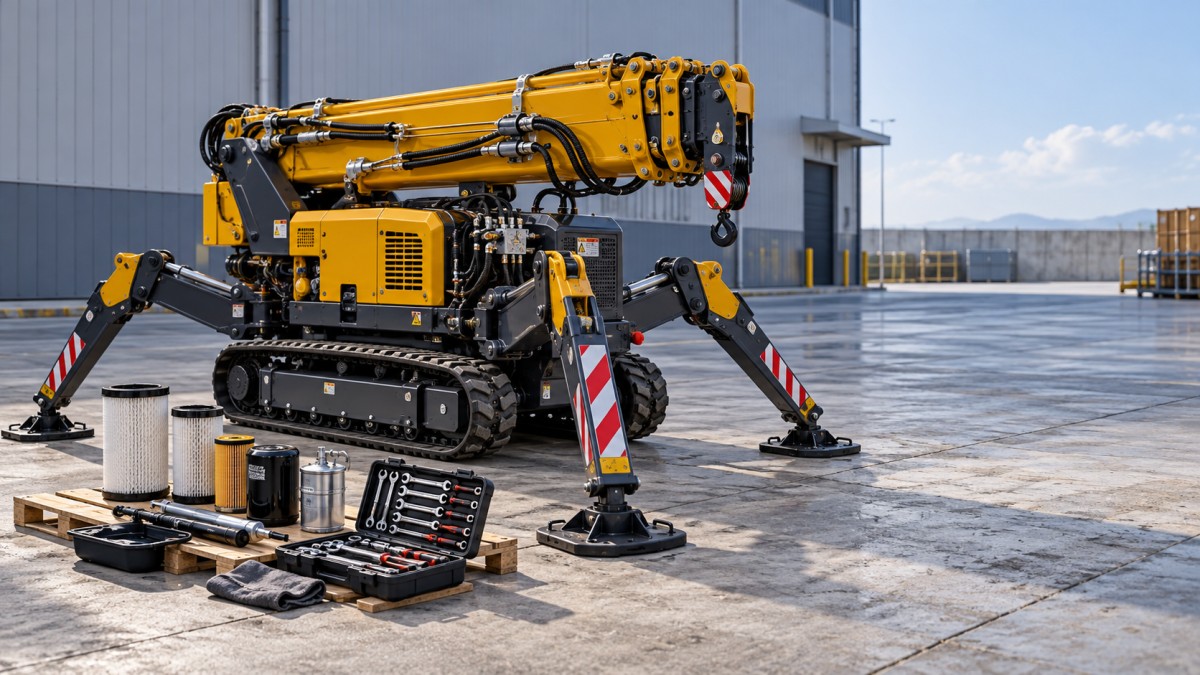
Include mobilization between projects. A compact crane still needs transport, loading arrangements, and sometimes access preparation. Model these costs per trip or project rather than per operating hour when that better reflects how invoices arise.
Use productive hours without counting downtime twice
A practical utilization calculation is:
Expected productive hours = scheduled working hours × technical availability × productive-use share.
The productive-use share captures time lost to matters other than mechanical failure, including access restrictions, incomplete work fronts, and gaps between jobs. Ensure these reductions are not already embedded in the scheduled-hours estimate. For intermittent work, a project-by-project schedule is more reliable than an assumed full working year.
Downtime has two distinct effects: it reduces output and can create additional cash costs. Lower productive hours increase the ownership cost per hour. Replacement rental, emergency freight, and contractual delay charges create separate expenditure. Include only incremental consequences, and avoid counting both replacement rental and the full loss of output if the replacement prevents that loss.
Support response assumptions with evidence: parts location, dispatch arrangements, technician coverage, and warranty exclusions. A warranty may cover an eligible component without covering transport, substitute equipment, or lost project income.
Calculate lifetime cost and discounted cash requirements separately
For an undiscounted screening calculation:
Lifetime ownership cost = initial ready-to-work investment + operating and support expenditure over the holding period + disposal costs − resale proceeds.
Depreciation is not another cash payment. Adding depreciation to the full purchase outlay double-counts capital consumption. Its tax effect can matter in an after-tax investment model, subject to local rules and the ability to use deductions.
The following figures are hypothetical, not market quotations. They illustrate a five-year holding period in a single reporting currency.
Lifetime cost is $100,000 + ($18,000 × 5) + ($20 × 2,500) − $25,000 = $215,000, or $86 per productive hour. At 300 hours annually, the same assumptions produce approximately $130 per hour. Utilization changes the result substantially without any change in purchase price.
For investment approval, discount each year’s net cash outflow using a rate consistent with the currency, inflation basis, and tax treatment. Discount resale proceeds too. If calculating an equivalent hourly cost, divide the present value of costs by the present value of productive hours—not by undiscounted lifetime hours.
Keep financing treatment consistent. An unlevered asset model records the investment and operating cash flows and uses an appropriate discount rate; it does not also add loan principal repayments. A separate financing schedule should show deposits, debt service, fees, and liquidity requirements.
Test rental against the same workload and risk exposure
Rental comparisons must include minimum hire periods, mobilization, operator provision, fuel, insurance obligations, overtime, and off-hire conditions. A quoted hourly rate may not represent the invoice for a short, remote assignment.
Using the hypothetical figures above, annual undiscounted capital consumption is $15,000: purchase less net resale, spread over five years. Adding $18,000 of annual fixed costs gives $33,000. If equivalent rental costs $110 per productive hour and ownership variable costs are $20, the simplified break-even utilization is $33,000 ÷ ($110 − $20), or about 367 hours annually. This screening result excludes discounting, tax, and any unmatched transport or staffing costs.
Run a downside case with lower utilization, longer repair delays, weaker resale proceeds, and adverse exchange rates on unpaid imports and spare parts. Model exposures by payment currency and date; do not apply one currency uplift to all costs.
An ownership case is strongest when the workload remains economic under those conditions and the funding schedule remains affordable. If it depends on near-perfect availability, immediate tax recovery, or an unsupported resale price, the purchase price is not the unresolved issue—the assumptions are.
Send Us A Message
Get a Quote
Regardless of whether you require general advice or specific support, we are happy to help you.