


Runtime, Charging Time, and Duty Cycle for Lithium-Powered Crane Drives
For a lithium-powered crane drive, runtime, charging time, and duty cycle should be evaluated as one operating system. A battery that appears adequate on a data sheet can still disrupt a project if lift frequency, hydraulic demand, idle periods, ambient temperature, or charging access were estimated incorrectly. Conversely, a well-matched electric drive can cover a planned shift with fewer interruptions than a diesel-dependent arrangement, particularly where work is concentrated, predictable, and supported by on-site charging.
For project managers, the first question is not “How many hours will it run?” It is: “Can it complete the required lifting pattern, with sufficient reserve, during the time window available?” That distinction matters because crane energy use rises and falls sharply with the work being performed. Travel, boom movement, hoisting, slewing, stabilizer deployment, hydraulic hold functions, and auxiliary loads do not draw power at the same rate.
Runtime Depends on Work Cycles, Not Shift Length Alone
Published runtime figures are useful only when the underlying duty cycle resembles the planned operation. A crane making occasional short lifts over an eight-hour shift may consume less energy than a crane working continuously for four hours at demanding boom angles and load radii. Counting shift hours without defining active lifting time is a common source of undersizing.
A practical estimate begins by separating the operation into repeatable cycles. For each cycle, identify the load, lifting height, outreach, hoisting speed, boom movements, slewing requirements, time under hydraulic power, and expected waiting time. The result does not need to be a perfect energy model to be useful. It needs to expose whether the crane spends most of its time waiting, performing light positioning work, or repeatedly operating near the higher end of its hydraulic demand.
For truck-mounted equipment, the installed crane and vehicle arrangement must be assessed together. A straight-boom crane may have modest capacity at long reach but much higher demand during frequent near-capacity lifts, rapid hoisting, or simultaneous hydraulic functions. For example, the Straight Boom FST3.2E3 requires up to 18 kW of power and up to 40 L/min of hydraulic flow. Those figures do not state battery runtime by themselves, but they establish the peak capability the electric drive system may need to support.
Project teams should also avoid planning around full battery discharge. A reserve is needed for unplanned lifts, lower-temperature operation, battery aging, detours in the sequence, and a charger that becomes temporarily unavailable. The required reserve will depend on the operating risk of the job, but a schedule that only works under ideal conditions is not a dependable schedule.
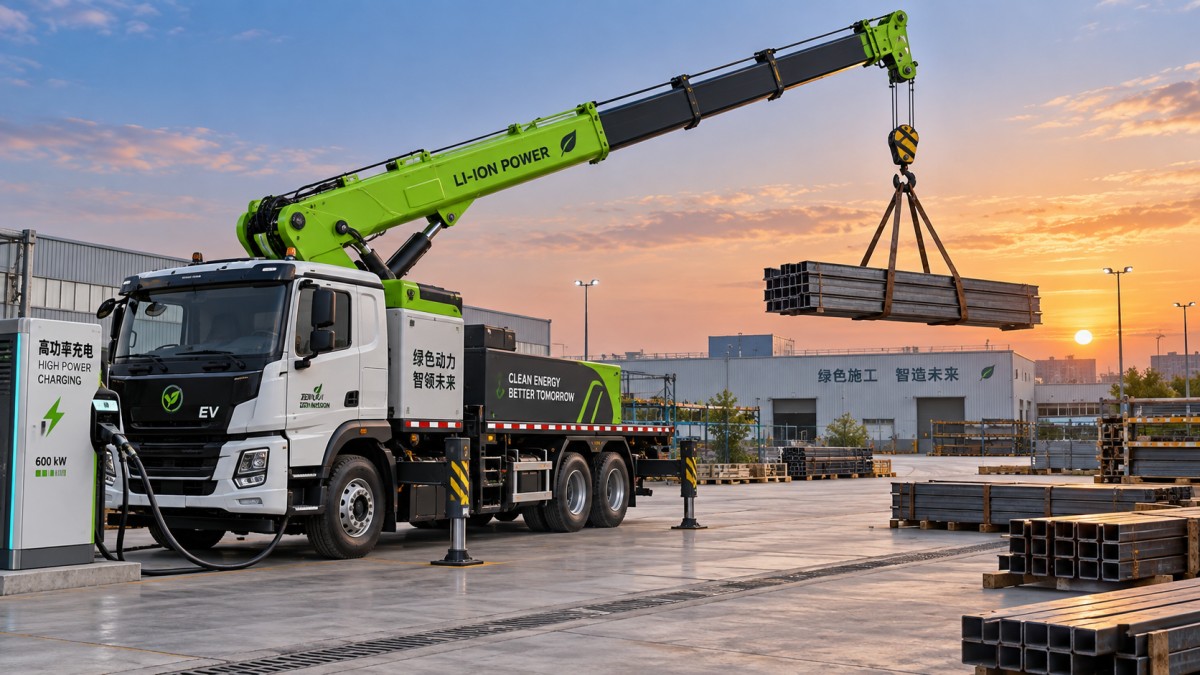
Peak Power and Average Energy Need Different Checks
Battery capacity determines how much energy is available over time, while the drive, inverter, battery management system, and hydraulic motor arrangement determine whether the crane can supply power during high-demand events. Both checks are necessary.
A system may have enough stored energy for a shift yet be unable to sustain the peak output required for a fast hoist, a high-pressure hydraulic movement, or a sequence of demanding lifts without power limiting. In that situation, the crane may still operate, but cycle times can lengthen. That affects production more than a simple runtime calculation suggests.
When reviewing a Lithum Motor system or any battery-electric crane drive, ask the supplier to distinguish between:
- usable battery energy rather than nominal pack capacity;
- continuous power available during normal lifting operations;
- short-duration peak power and the conditions under which it is available;
- any control strategy that reduces speed or function priority as battery state of charge falls;
- the expected hydraulic performance at the planned working pressure and flow;
- energy consumption assumptions used in the runtime estimate.
The last item is especially important. A runtime claim based on intermittent, light-duty positioning cannot be used to schedule repetitive material handling or installation lifts. The work pattern must be described in operational terms: lifts per hour, average load, maximum expected load, radius, duration of hydraulic activity, and breaks between lift groups.
Charging Time Is a Scheduling Constraint
Charging is often discussed as a technical specification, but it is primarily a planning constraint. The relevant question is whether charging can happen during the actual gaps in work. An overnight window is useful for a single-shift site with secure power access. It provides little protection for a two-shift schedule, a remote work zone, or a project where the truck changes location throughout the day.
Charging time depends on usable energy to be replenished, the charger output available at the site, battery charging limits, and the operating temperature of the pack. The charging equipment may be capable of a high output, yet the site connection, distribution board, cable run, or shared electrical demand may limit delivered power. Project planning should therefore account for the charging infrastructure rather than treating the charger rating as a guaranteed field result.
There are three charging strategies worth comparing during selection:
- Overnight charging: Suitable where the crane returns to a fixed base or remains at a secured site and the next day’s duty cycle is predictable.
- Opportunity charging: Uses breaks between work packages, deliveries, or crew changes. This can increase usable daily operating time, but only if the connection point is close and access is reliable.
- Planned mid-shift charging: Builds a charging stop into the work sequence. It can support demanding schedules, although it must be treated as a production activity with allocated time, space, and electrical capacity.
For mobile crane work, the location of the charger deserves as much attention as its power rating. A charging point that requires moving the truck, rerouting access, or blocking another trade can become operationally unavailable even when it exists on site. Managers should confirm cable routing, protection from vehicle traffic, weather exposure, access control, and who has authority to use the supply.
Duty Cycle Should Be Defined Before the Drive Is Chosen
Duty cycle is the share of time in which the crane is actively performing power-demanding work, but its quality matters as much as its percentage. Ten minutes of light, low-pressure positioning is not equivalent to ten minutes of repeated high-load hoisting at a large radius. The duty-cycle definition should capture intensity as well as duration.
One useful approach is to classify planned work into three bands: routine lifts, heavy or high-reach lifts, and recovery or idle periods. Then examine the sequence. A drive system can often recover thermal and electrical margin during genuine idle time, while clusters of heavy lifts may create a peak-demand condition that cannot be inferred from the daily average.
The crane’s load chart remains central to this assessment. A unit rated for 3.2 tonnes at a 2.5 m radius, for instance, will not have the same operating profile at a 10.25 m radius, where the available hook load may be far lower. Reaching farther can increase the duration and precision required for a lift even when the lifted mass decreases. Battery sizing therefore needs the intended load-and-radius mix, not only the maximum capacity figure.
Watch for These Planning Errors
- Using nominal battery capacity as though all stored energy is operationally usable.
- Assuming a low average load automatically produces low energy consumption, while overlooking high lift frequency or long hydraulic run time.
- Specifying a charger before confirming site electrical capacity and the actual charging window.
- Planning a second shift around a battery recharge that has no protected time in the programme.
- Ignoring cold-weather, high-temperature, or battery-aging effects when setting the daily reserve.
- Evaluating crane runtime separately from vehicle travel, auxiliary equipment, and other electrical loads where they share the same energy source.
Build the Decision Around the Work Programme
The strongest basis for a lithium-powered crane drive decision is a representative operating schedule rather than a generic comparison with diesel equipment. Map the expected lifts by load, radius, and sequence; define active hydraulic time; identify the longest uninterrupted work period; and establish where charging can occur without compromising the programme. Then test whether the system retains an operational reserve after the demanding part of the day, not merely after an average day.
Where work is repeatable and charging can be controlled, battery-electric crane drives can be planned with considerable confidence. Where the lift sequence is highly variable, access to power is uncertain, or peak hydraulic demand is sustained for long periods, the specification needs more margin and a more deliberate charging plan. Runtime is ultimately a project scheduling issue expressed through the battery, drive, and crane configuration.
Send Us A Message
Get a Quote
Regardless of whether you require general advice or specific support, we are happy to help you.